Monday, 27 May 2013

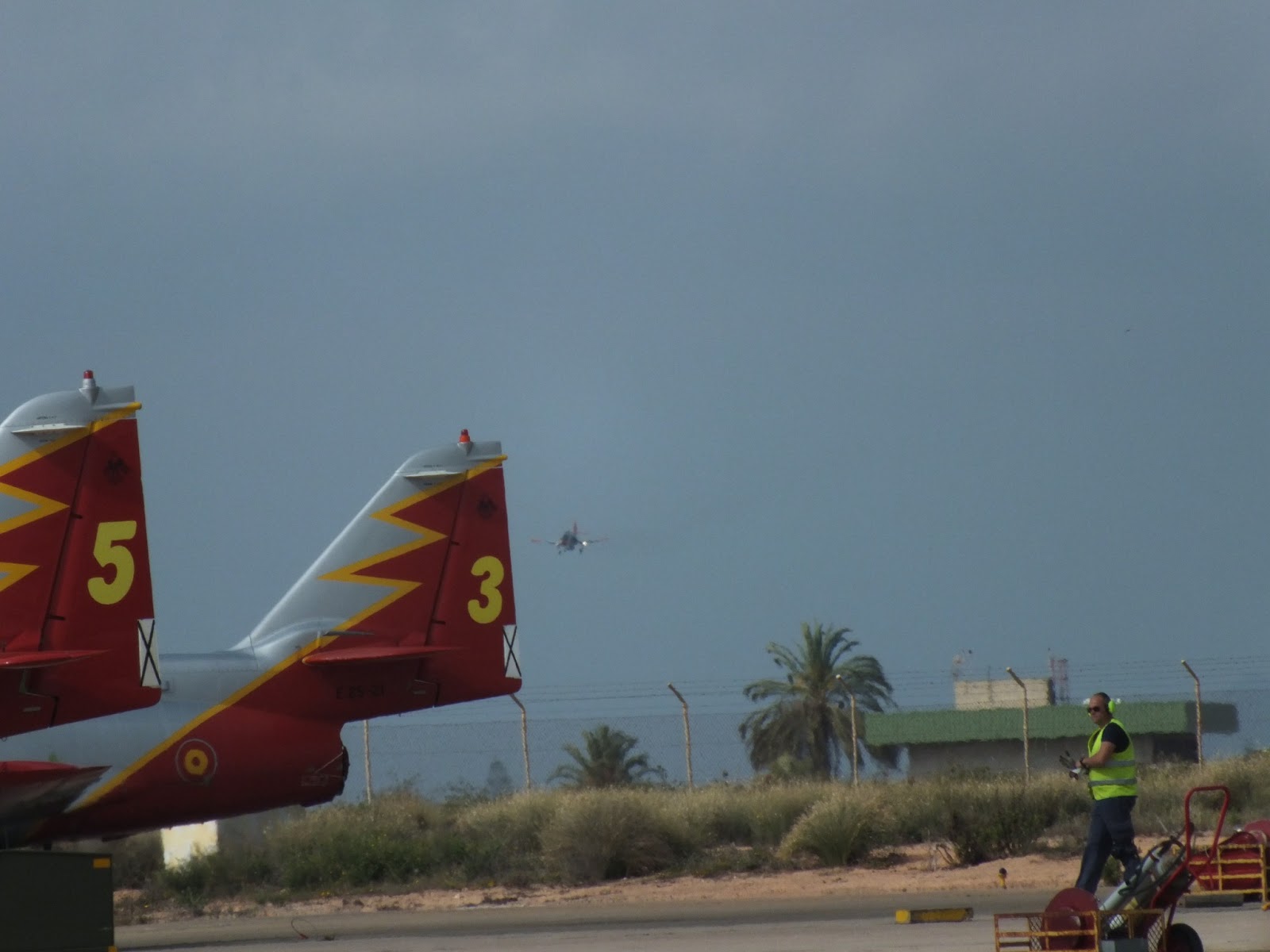
A close-up of the planes that fly over our house every day.

   This year is the 125th anniversary of the town of Santiago de la Ribera, next door to which is the Academia General del Aire which trains pilots, and is home to the "Eagle Patrol", which is the Spanish equivalent of the Red Arrows in UK.
   To acknowledge this, the Acadamia is holding 4 open days in May and June to celebrate. We were lucky enough to see the invitation on the internet in good time, and got our names down for Friday 24th May. 35 people attended and we started by watching the flag ceremony, then watching the salute being taken from the company.


Taking the salute

   After a tour around the buildings and a visit to the regimental museum, we had a filmshow about the work and leisure of the Eagle Patrol and had some questions and answers.
Regimental museum
   Having been told the tour was approx one and a half hours long we assumed that was the end and we were going home. However, at the T junction, we turned not left for the exit but right for the airfield!!
   There are 3 types of plane operating from the Acadamia. The first is a propeller trainer, then a jet trainer, then the jet they use for the displays. We can see them practicing every day from our roof terrace at home - sometimes just 2 propeller planes, sometimes 2 jet trainers and sometimes a complete display routine complete with coloured smoke.
   To our amazement there was a propeller trainer and a jet trainer on the apron with the canopy open and steps in place. We got to sit in the propeller one, but not the jet because it had a live ejector seat in it which the pilot said was "cero cero" (zero zero). This means it can eject at zero speed and zero altitude, so if you sat in it and weren't strapped into the seat and touched the release handle under the seat - well you can imagine. (I don't think they were insured for that!)
Jet trainer

Inside the jet trainer - don't touch that handle!!

Propeller trainer and instructor (and pupil)

Biggles!

The Red Baron
   Whilst we were on the apron 3 propeller trainers landed, followed by 3 display jets - all very exciting and very loud. This was totally unexpected and was a real bonus.
   All in all a fantastic experience and insight into the workings of a military base which I would recommend to anyone - if you get the chance - do it.
Two prop trainers just landed

Handbrake on

Now for the debrief

Display jet

Two down and one incoming
Link to all pictures at Acadamia del Aire here


Sunday, 26 May 2013

Valeria

   We bought an inflatable kayak from Decathlon in UK a couple of years ago (thank you Colin - brilliant advice) with the intention of bringing it to Spain to use. We did this in spring of 2011 (checked in baggage) and had a fabulous time with her.
   We named her Valeria after a 6 week old baby which a man had on his knee in a bar called Bodegan la Pena in our home town, which we thought was a good name for a boat.

   30 mins cycle ride south of us is the Mar Menor. This is an inland sea, joined to the Mediterranean by 2 canals. There is a spit of land called La Manga (the sleeve) that separates the Mediterranean from the Mar Menor. This means the Mar Menor is sheltered from the worst of the weather as regards wind and waves, is 5°+ warmer than the Med, and there is no risk of being swept out to sea and ending up in Algeria. This is where we use Valeria the most.
   To get her to the Mar Menor we bought a bike trailer into which she fits, along with the pump, seats, paddles, coolbox with food and drink, baler, mooring rope (string!), and drybag for valuables.
   The first year we used her we found we could paddle into the wind with no problem and make good progress, but trying to go downwind or crosswind meant a haphazard series of zig-zagging along and going round in circles. Prior to leaving work I took good advice from an experienced canoeist (thanks Colin) and bought a "skeg" in a quiet moment at work.This is like a rudder at the back but it doesn't move, so it gives you a degree of stability and direction when moving forward.
   Our first launch this year was the first opportunity to try the skeg, so on May 25th we set off for the Mar Menor, and what a revelation. Valeria now goes where you point her no matter where or how strong the wind is, so no more 360's. The weather was sunny, 26° and cloudless at 10:00am when we got there, with a light westerly breeze - just as forecasted. An excellent 2 hours of pottering about found us amongst the moored boats near the beach - time for lunch.

   At 1:00pm we decided to head back to the bikes and trailer (2kms up the walkway from the mudbaths), but found the wind was now from the east, and considerably stronger. Waves were crashing over the front, and paddling against the wind and waves was something that now required concentration and stamina. We eventually made it but it was touch and go at some points - we were never in danger, but it would have been a long walk back. This was so different from the conditions of July and August when we used her the previous year, when the weather was relatively calm and predictable.
   So, as any sailor will tell you, never underestimate the power of the sea - even if it is enclosed and shallow, and above all leave yourself an escape route (ours was the beach bar on the way home).


Tuesday, 7 May 2013

Internet at last!

After ages without internet we are finally online again.
After touring the lakes we thought a visit to the Camargue would be good, so we had 3 excellent days there - brilliant place.
The lure of the sun in Spain had us heading south, and we are currently wild camping on the banks of the river Segre, just before it joins the Ebro, in a place called Mequinenza, between Lleida and Zaragoza.
Should be home in a couple of days, when the full tour will be revealed.
Wild camping next to the River Segre 

Tuesday, 30 April 2013

Quick update

Made our way to Switzerland and saw 3 stages of the Tour De Romandie including the finish in Geneva.
Now working our way back with a tour of more lakes (Annecy and Bourget), after having seen Lake Garda, Como, Iseo, Maggiore, Lugano and Leman!
Weather is dire at the moment, but it's the same all over Europe at the moment.
Full update on our return.
Here are some views of the mountains and valley near Locarno in Switzerland (Lake Maggiore in background), and Lac Leman in the mist.


Wednesday, 24 April 2013

Tour update

Just a quick update now we have found some decent wifi after being on the road for a couple of weeks!  We had a flying visit back to UK to visit my mum and our daughter, then when we got back to Spain Brian found details of a cycle race in northern Italy called the Giro del Trentino which Bradley Wiggins was using as a warm-up for the Giro d'Italia, so we had 3 days to get there!!  Cervantes surpassed himself on the journey.  We saw Brad on two mountain top finishes and we were the only Brits up there!  Got to speak to him as well!

After that we planned to see the Italian lakes and then head for home, but we heard of yet another cycle race, this time in northern Switzerland called the Tour of Romandie and Mark Cavendish and Chris Froome were going to be competing, so we headed throught the Simplon Tunnel on a car train and here we are in a place near Sion surrounded by snow-capped alpine peaks - beautiful.

More updates when we find a good connection-if not, we'll do a full itinerary when we get home!

Glyn x

Thursday, 4 April 2013

A real gem of a find

Monday 1/4/13, Tuesday 2/4/13 and Wednesday 3/4/13

I am talking about a very special motorhome park we have found called Camper Park Huerta de Murcia which is between Murcia and Orihuela. It's a really peaceful site in the countryside surrounded by orange and lemon groves, with the nice Spanish town of Alquerias only 800m away. Lots of bars and restaurants and not a word of English spoken - perfect.


   The aire is run by a lovely woman who gave us a bag of lemons on arrival. To reciprocate, Glyn gave her some home made lemon posset (lemons, cream and sugar) when we left. She was very impressed, and said when we returned in summer she would give us some home made lemon granizado (like sorbet) to make margaritas with, so we are obviously going back and holding her to it.
   The site was excellent with good showers and toilets, seating areas etc, but best of all was a dedicated cycle track along the River Segura to Murcia one way (8km) and Orihuela the other(12km)


So for €12 per night (including electric hook-up and free wi-fi) you have a traffic-free route to the centre of Murcia that takes 35 mins max by bike.
   On the Tuesday in Murcia it was the "Desfile del Bando de la Huerta", which is a procession to celebrate anything and everything to do with the production and distribution of food in the countryside (huerta). This consisted of over 2 hours of tractors, old bikes and motorbikes, horses, donkeys, oxen and mules, floats giving away produce, carnival queens, with all the people involved dressed up in traditional costume - what an atmosphere!


   Our intention was to go further north to Fortuna, but this aire was so good we stayed there for 3 nights and explored the Casino in Murcia on Wednesday - a fantastic renovation of a beautiful building.


   We would recommend this aire to anyone who wants genuine Spanish quiet countryside, easy access to Murcia, and the friendliest welcome in Spain - fantastic!
   Full picture gallery here

Sunday, 31 March 2013

A Spanish Easter - Semana Santa

   Spain is mainly a Catholic country and as such, religious ceremonies are very important; the most important of which is Easter.
   Even the smallest village with a church has some sort of procession and celebration, and the bigger the village/town/city, the bigger and more elaborate are the statues and processions. Regardless of your religious beliefs, the proceedings are very moving.
   Our local town is small to medium sized (population of approx 24,000) and has 8 processions over 7 different days. Drums are present at every procession - sometimes just the single drumbeat, and sometimes accompanied by bugles and wind bands.
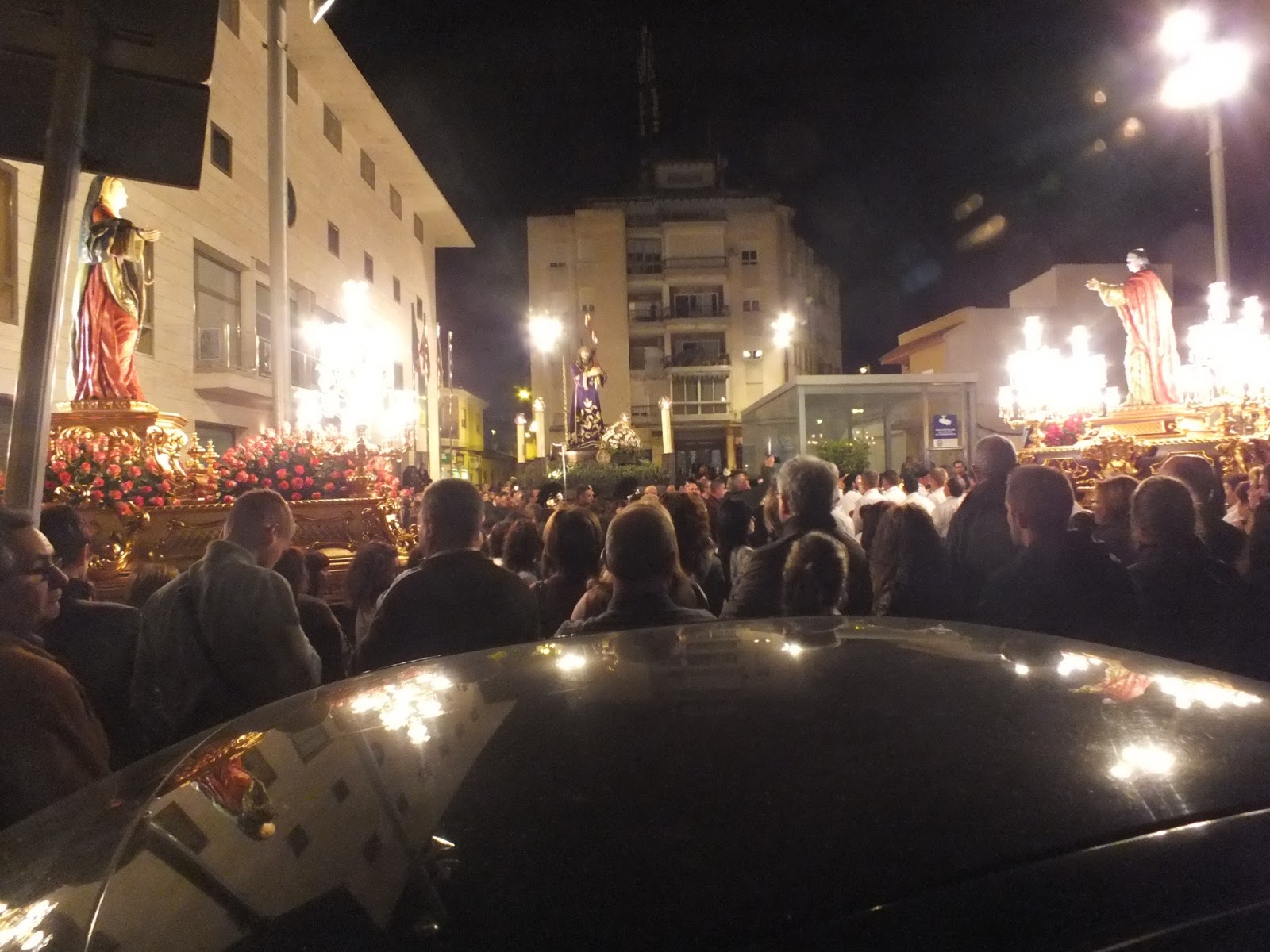
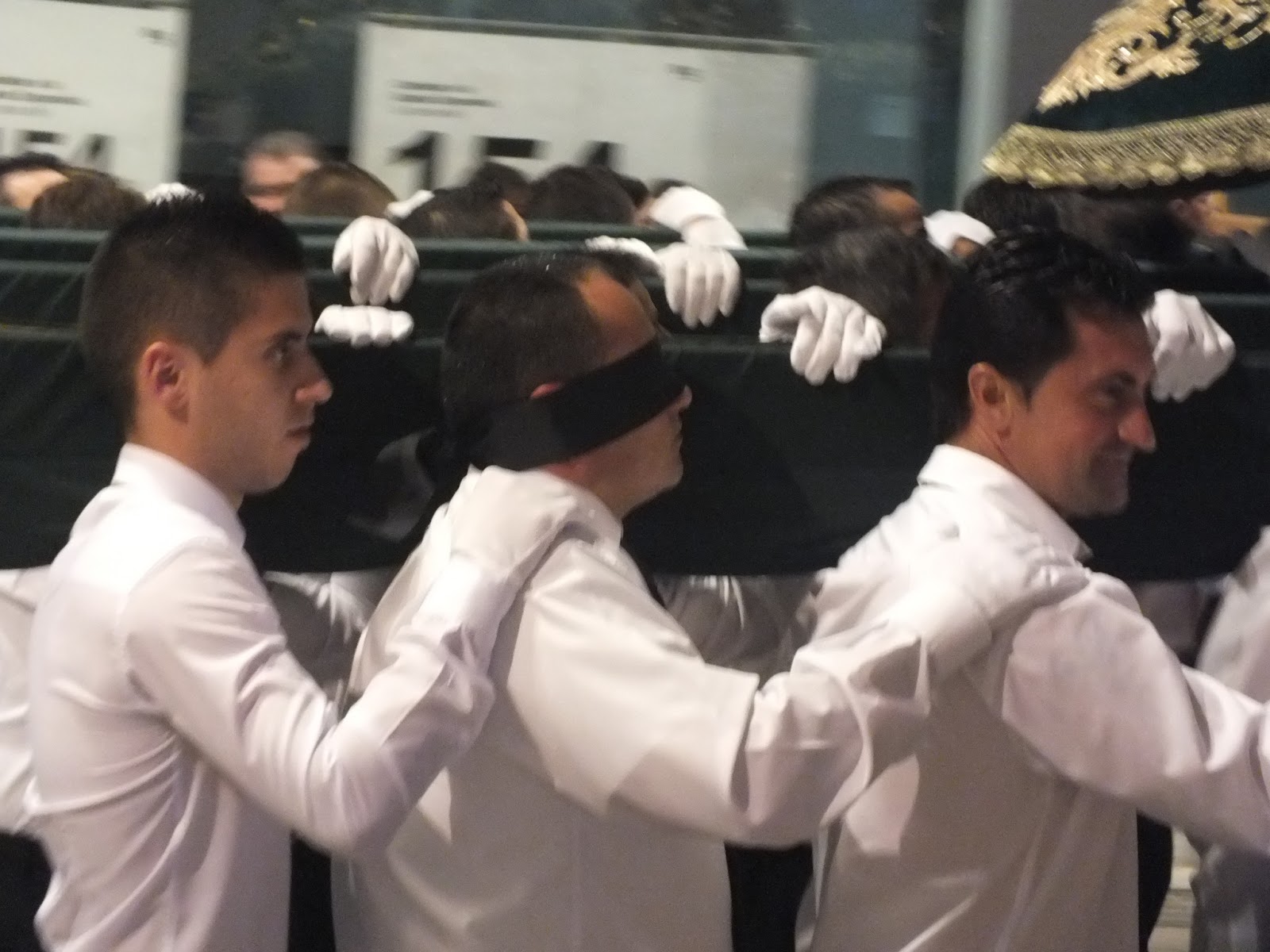
   The processions consist of a huge statue on a base (a trono) carried on the shoulders of up to 70 people (known as Nazarenos) who belong to a range of brotherhoods (called Cofradias). Each Cofradia has its own statue, standard bearers, members and followers. Co-ordinating the lifting and movement of these huge tronos is a major feat of organisation - supervised by a person at the front who rings a bell to give different instructions to the people carrying the trono.
   The trono usually leads the procession followed by various groups. First is usually the band of drummers, sometimes alone and sometimes accompanied by bugle bands or wind bands. Second are the members of the Cofradia who dress in floor-length robes and wear pointed hats (called capirotes) with masks attached which cover their faces and have only slits for eyeholes. The capirote has its origins in the Spanish Inquisition, when people who were punished for religious reasons were forced to wear them, so everyone would identify it as a sign of penance. Third are the general public carrying palms, candles or whatever is pertinent to the procession. The procession winds around the backstreets until it emerges onto the main street (the Calle Mayor) and ends in the Church square.
   Mass is said many times each day except for Good Friday, which is the only day in the Catholic Church when Mass is not said.
   All ages are represented in the processions, from 3 years to 93 years - each playing their own part. Religion really is a cradle to grave commitment in Spain.

Friday March 22nd
This procession is called "Via Crucis" or the path of the cross. Along the route are 14 stations of the cross, and at each one the procession stops and a reading is given. This of course takes a tremendous amount of time and can last for hours. On the previous day  the Via Crucis for children was held, but with a much reduced route.
Full photo gallery here 

Sunday March 24th
Two processions today, the first being the Procession of the Palms representing Jesus' triumphant entrance to Jerusalem. Just the one trono in this, which is a joyous procession with lots of music and celebration, with everyone carrying palm fronds or olive branches.
Later there is the Procession of the Capes (Mantillas) which symbolises the hopes of a Mother, with an enormous trono and a huge statue of Mary with a long flowing cape. The roof and the cape are covered in flower petals that fall onto the procession as it moves.. Many of the statues are so tall that to get them through the narrow back streets, a cofradia member is supplied with a hook on a long pole to lift up the electricity wires which stretch across the streets, to allow the trono to pass underneath. Again a joyful celebration of a procession.

Full photo gallery here and here 

Wednesday March 27th
An evening procession (starting at 10:30pm) which involves 4 different tronos starting at 4 different points. The procession is called "Procession of the meeting at the street of bitterness", in which Jesus carrying the cross and his grieving Mother meet, surrounded by Pious Veronica and the Beloved Disciple. This is a masterpiece of choreography and timing and is wonderful to see - the result of hours of practice.


Back in the church square the trono with Jesus carrying the cross was lowered onto the ground, and all the rosemary surrounding him was picked by the Nazarenos and given to the waiting crowd.
Full photo gallery here 

Thursday March 28th
This is a very solemn and quiet procession with only the sound of a single drumbeat to accompany it. It is called the procession of silence, and the statue of Christ Crucified is very moving, made all the more so when all the street lights are turned off, and only the candles light the cross.
Full photo gallery here 

Friday March 29th
This is the main procession of the week called the holy burial general procession which contains all the tronos already seen and some new ones - a total of 10 tronos. We stood in one spot near the start, and the whole procession took over 2 hours to pass us. It symbolises carrying Jesus' body to his final resting place, and is very sombre and powerful. Some members of the Cofradia take penance to the next level and carry their tronos blindfolded or in bare feet.


Full photo gallery here

Sunday March 31st
Called the meeting procession, this is a joyous occasion as Christ returns from death and comes back to meet his mother. Just the 2 tronos today with an altar set up on the main street to bless them. Lots of joy with firecrackers and confetti with religious images on it. Unfortunately this was rain affected but still went ahead. However in Seville, where the processions and celebrations are some of the biggest in the country, some processions had to be cancelled due to the rain, which resulted in anguish and tears from the penitents and organisers who had spent the previous 12 months preparing for this very important event.


Full photo gallery here